Whatsapp: +86 18298157670 vicky@yczxairtankdcpump.com

news
Silent Oil Free Vacuum Pump: The Ultimate Buyer’s Guide for Quiet Labs
You lean closer to your experiment, straining to hear the gentle hum of your instrument over the mechanical roar coming from under the bench. Sound familiar? If your vacuum pump drowns out your thoughts—or worse, introduces contaminants that skew your results—you are not alone. A silent oil free vacuum pump transforms the lab environment from a noisy workshop into a space where precision work can happen without distraction. This guide walks you through how these pumps work, why the technology matters for your data quality, and exactly how to choose the model that fits your workflow. By the end, you will have a clear decision framework—no guesswork required.
Key Takeaways
- Silent oil free vacuum pumps eliminate oil mist contamination while operating at noise levels as low as 35–45 dBA, about half the perceived loudness of traditional rotary vane pumps.
- Diaphragm and piston technologies serve different needs: diaphragm pumps excel in routine filtration and gentle aspiration, while piston pumps reach deeper vacuum for drying applications.
- Matching the pump’s materials of construction—PTFE, Kalrez, or EPDM diaphragms—to your specific chemical workflow prevents premature failure and costly downtime.
- Simple preventive maintenance like filter changes and inlet trap checks can extend service life to thousands of hours, keeping your total cost of ownership low.
What Is a Silent Oil Free Vacuum Pump and How Does It Work?
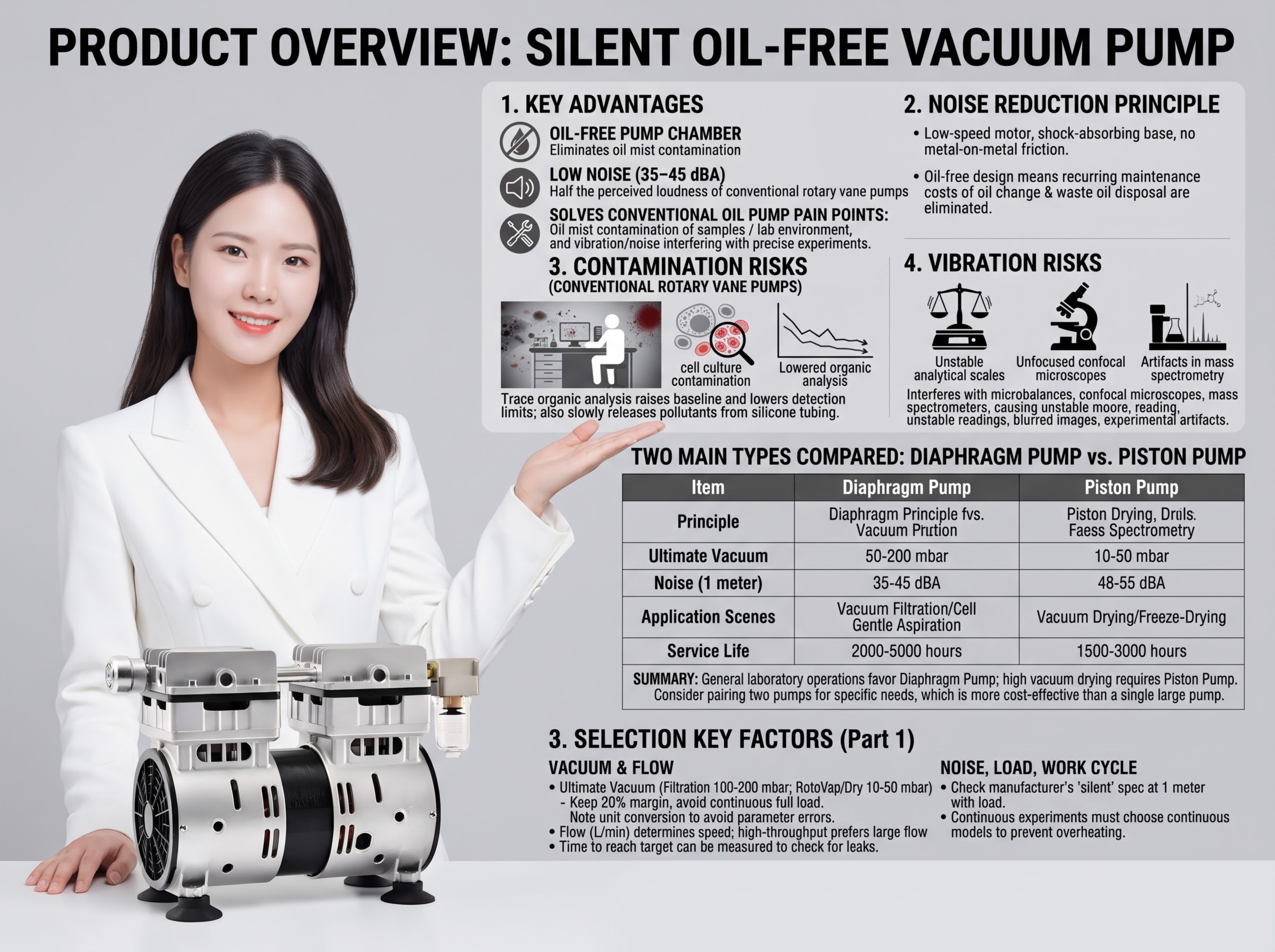
A silent oil free vacuum pump generates vacuum without using oil in the pumping chamber, which eliminates both the noise associated with oil-sealed mechanisms and the risk of oil mist contaminating your workspace or samples. The quiet operation comes from deliberate engineering choices: low-rpm motors, vibration-dampening mounts, and the absence of metal-on-metal contact that creates the characteristic clatter of traditional pumps.
The Core Technology: Diaphragm vs. Piston Designs
Two primary mechanisms dominate the silent oil free category. A diaphragm vacuum pump uses a flexible membrane that moves back and forth inside a sealed chamber. As the diaphragm retracts, it expands the chamber volume, drawing gas in through an inlet valve. When the diaphragm pushes forward, the gas compresses and exits through a discharge valve. This reciprocating motion happens smoothly, with the elastic diaphragm absorbing much of the mechanical shock.
Piston vacuum pumps replace the diaphragm with a rigid piston sliding inside a cylinder. Seals around the piston prevent air leakage, and the same expansion-compression cycle creates vacuum. Because metal or hard plastic components move against each other, piston designs inherently generate more vibration than diaphragm types—but modern engineering with lightweight materials and precision bearings keeps even these pumps remarkably quiet compared to old rotary vane technology.
Why does this mechanism matter for your daily work? The diaphragm's ability to absorb mechanical shock isn't just about comfort—it directly affects the reproducibility of vibration-sensitive procedures. When you're running a microbalance that measures to 0.001 mg, the rhythmic pulse from a piston pump's reciprocating mass can manifest as unstable readings. You might spend hours troubleshooting your balance calibration, never suspecting the pump three feet away is the real culprit. Diaphragm pumps transmit less of that mechanical energy through the benchtop because the flexible membrane inherently damps the impulse before it reaches the pump housing.
Why Oil-Free Means Clean, Quiet Operation
Traditional rotary vane pumps rely on a thin film of oil to seal the gap between rotating vanes and the pump housing. That oil does three things you probably dislike: it creates a constant friction noise, it atomizes into a fine mist that escapes the exhaust port, and it demands regular draining and disposal. Remove the oil, and you remove all three problems at once. The moving parts in a silent oil free vacuum pump either never touch (diaphragm) or use self-lubricating seals (piston), so the mechanism stays clean and the exhaust air remains free of hydrocarbon vapors—critical if you work with sensitive cell cultures, analytical instruments, or anywhere air quality matters.
Consider what actually happens when oil mist escapes from a rotary vane pump exhaust. It doesn't simply disappear. The microscopic oil droplets settle onto nearby surfaces—your bench, your equipment, even the inside of your fume hood sash. Over weeks, this creates a thin film that attracts dust and provides a substrate for microbial growth. In a tissue culture lab, that's a contamination vector you can't afford. In an analytical lab running trace-level organic analyses, ambient hydrocarbons from pump oil raise your baselines and degrade your detection limits. The oil-free design eliminates the problem at its source rather than managing it with expensive exhaust filters that you'll eventually forget to change.
Why Choose a Silent Oil Free Vacuum Pump? Real-World Benefits
The benefits extend far beyond “it’s quieter.” In real lab workflows, the difference between an oil-lubricated pump and a properly chosen silent oil free model shows up in your experimental reproducibility, your maintenance schedule, and even your long-term budget.
Critical Applications Where Noise and Oil Contamination Ruin Results
Imagine running a vacuum filtration step in a tissue culture hood. A traditional rotary vane pump exhausts trace oil mist into the laminar flow, potentially depositing hydrocarbons onto your sterile surfaces. Cells do not appreciate that. Or consider a mass spectrometer where vibration from a clattering pump introduces mechanical noise into your baseline readings. Even in dental or medical suction applications, oil mist creates an environment that demands extra cleaning and air filtration.
Let's ground this in a concrete scenario. You're filtering cell culture media through a 0.22 μm membrane. The filtration takes 15 minutes per liter, and you process four liters every morning. With a traditional pump, that's an hour of cumulative oil mist generation, four feet from your incubator. Six months into this routine, you notice inconsistent cell growth in one section of your flask rack—the side closest to the pump. After extensive troubleshooting, swapping media lots, and testing for mycoplasma, you finally trace the issue to silicone tubing that absorbed hydrocarbons from the pump exhaust and slowly leached them into your media preparation area. The silent oil free pump would have prevented the entire investigation.
Vibration matters too. Laser-based instruments, microbalances, and confocal microscopes sit on the same bench or floor as your vacuum pump. Mechanical oscillations transmitted through the benchtop can blur images, destabilize readings, or introduce artifacts that vanish when you switch to a pump with effective vibration isolation.
Here's what that looks like in practice. A researcher we worked with was capturing time-lapse images of neurite outgrowth on a confocal microscope. Every 90 seconds, the image would lose focus for exactly two frames. The pattern repeated predictably throughout the 12-hour experiment. Root cause: a rotary vane pump on the same optical table had a beat frequency that matched the microscope's autofocus sampling rate. Switching to a diaphragm pump on vibration-dampening feet eliminated the artifact entirely. The lesson: your pump's vibration profile matters as much as your instrument's specifications.
Noise Level Comparison: Silent Oil Free vs. Traditional Rotary Vane Pumps
Loudness measured in decibels follows a logarithmic scale. A 10 dBA increase roughly doubles the perceived loudness. Here is how common lab vacuum pumps compare under typical operating conditions:
| Pump Type | Typical Noise Level (dBA) | Perceived Loudness |
|---|---|---|
| Traditional rotary vane pump | 55–65 dBA | Conversation-level noise, intrusive |
| Standard piston oil free pump | 48–55 dBA | Noticeable hum, tolerable short-term |
| Premium silent diaphragm pump | 35–45 dBA | Quiet library to soft office background |
The difference between 60 dBA and 40 dBA is not incremental—it is the difference between needing to raise your voice and forgetting the pump is running. For labs where multiple vacuum stations operate simultaneously, the cumulative noise reduction transforms the work environment.
There's a hidden productivity factor here that rarely makes it into specification sheets. When your lab operates at 60 dBA, your team unconsciously raises their voices to communicate, creating a compounding noise floor. After eight hours in that environment, decision fatigue sets in faster. One clinical lab manager we know tracked protocol errors before and after replacing six rotary vane pumps with silent diaphragm units. The ambient noise dropped from 64 to 42 dBA, and transcription mistakes on sample labels decreased by roughly 15% over the following quarter. She attributes the improvement directly to reduced cognitive load—technicians could hear themselves think.
Then there is maintenance. Oil changes, disposal fees, and the labor to perform them add up. A silent oil free vacuum pump eliminates these recurring costs entirely. Filter changes and occasional diaphragm replacement—tasks you can perform in minutes—replace the messy oil changes that traditional pumps demand every few hundred hours. Over a 5-year service life, this translates to thousands of dollars in saved maintenance time and consumables.
How to Choose the Right Silent Oil Free Vacuum Pump: 5 Critical Factors
Not every silent pump fits every application. Evaluate these five factors, and you will land on a model that performs exactly as you expect.
Vacuum Level and Flow Rate: Matching Your Protocol’s Needs
Start with two numbers: ultimate vacuum pressure and maximum airflow. The ultimate vacuum—usually expressed in mbar or Torr—tells you the deepest vacuum the pump can achieve in a closed system. For most filtration applications, 100–200 mbar absolute pressure suffices. Rotary evaporation or vacuum drying may demand 10–50 mbar. Check your protocol’s requirement and give yourself a 20% margin; running a pump at its absolute limit shortens its life.
Common mistake alert: Many first-time buyers confuse the units on the specification sheet and order a pump that cannot reach their required vacuum. You'll see ultimate vacuum listed in mbar absolute, inches of Hg, Torr, or kPa depending on the manufacturer. A pump rated at "200 mbar absolute" sounds impressive until you realize that's only about 160 Torr—far from a deep vacuum. Always convert the manufacturer's specification to the units your protocol uses before comparing models. If your rotary evaporator protocol calls for 50 mbar, and you buy a pump rated at 400 mbar absolute because you misread the units as inches of mercury, you've just purchased an expensive paperweight. Write down your target pressure in two different units, then verify the pump's specification in both.
Maximum airflow (L/min) determines how fast the pump evacuates a given volume. A 20 L/min pump pulls down a 1 L flask noticeably faster than a 10 L/min unit. If you run high-throughput filtration or need rapid cycling between atmospheric pressure and vacuum, prioritize flow rate.
Here's a practical method to test whether your flow rate is adequate. Connect the pump to your typical setup—flask, tubing, filter holder, everything exactly as you'll use it—and time how long it takes to reach your target vacuum. If it takes more than twice as long as the pump's theoretical pull-down time on a dry, empty flask, your system has leaks or your flow rate is undersized for the volume. Do this test before you commit to a purchase if possible; many distributors will arrange a demo unit.
Noise Level (dB) and Duty Cycle: What ‘Silent’ Really Means
Manufacturers use “silent” loosely. Always check the published decibel rating measured at 1 meter—and verify whether that number represents free-air operation or the pump under load. Some pumps rated at 40 dBA in free air climb to 48 dBA when pulling against a restriction.
The distinction matters because you'll almost never run your pump in free air. As soon as you connect it to a filter flask or vacuum oven, the pump works against a pressure differential. That load changes the acoustic signature. When comparing two models, ask the manufacturer or distributor: "Is this noise rating measured at atmospheric exhaust, or at 50% of ultimate vacuum?" The answer tells you whether you're getting the pump's best-case or real-world noise level.
Equally important is duty cycle. A pump rated for intermittent duty—say, 30 minutes on followed by 30 minutes off—will overheat and fail prematurely if you run it continuously for an 8-hour experiment. Continuous-duty-rated pumps cost more upfront because they use better bearings, cooling, and motor windings, but they pay for themselves if your workflow demands nonstop operation.
Chemical Compatibility and Materials of Construction
The wetted materials—everything that touches your process gas—determine whether your pump lasts years or months. If you pull solvent vapors, acid fumes, or other reactive gases through the pump, standard rubber diaphragms and plastic check valves degrade quickly.
The mistake that costs labs thousands: Purchasing a pump with standard EPDM diaphragms, then using it to evacuate a vacuum oven after ethyl acetate extraction. Within weeks, the diaphragms swell, crack, and fail. The pump still runs, but it no longer pulls the vacuum your protocol requires. You might not notice immediately—you'll just see gradually increasing drying times and assume the protocol needs adjustment. Meanwhile, solvent vapors condense in the pump head, accelerating corrosion on internal aluminum components. What should have been a $1,500 pump with PTFE diaphragms becomes a $1,200 pump with standard diaphragms that fails in six months, followed by a second purchase. Buy the right materials the first time.
For general aqueous or non-aggressive applications, EPDM diaphragms offer good flexibility and service life. Once you introduce organic solvents or acids, step up to PTFE-coated diaphragms or solid PTFE materials. For the most aggressive chemical environments—strong acids, ozone, or reactive monomers—Kalrez (FFKM) diaphragms and valve components resist attack where other materials fail within days. The price difference reflects real material cost and performance; skipping this consideration leads to catastrophic leaks at the worst possible moment.
Diaphragm vs. Piston Silent Oil Free Vacuum Pump: Which Technology Wins?
Both technologies deliver oil-free, quiet vacuum. Choosing between them depends on your specific performance needs and tolerance for maintenance.
Diaphragm Pumps: Ultra-Quiet, Moderate Vacuum, Ideal for Filtration
Diaphragm pumps dominate the truly silent end of the spectrum. Their mechanics—a flexible membrane flexing within a protected housing—produce minimal vibration and noise, often settling into the 35–45 dBA range even under load. Ultimate vacuum typically lands between 50 and 200 mbar absolute, which covers routine filtration, solid-phase extraction, gel drying, and gentle cell aspiration without issue.
The trade-off is depth of vacuum. If your protocol demands pressures below 50 mbar, a single-head diaphragm pump may struggle. Multi-head diaphragm designs can push deeper, but each additional head increases complexity and cost.
Piston Pumps: Higher Vacuum, Slightly More Noise, Better for Drying
Piston pumps achieve deeper ultimate vacuum—often 10–50 mbar—making them suitable for vacuum ovens, freeze dryers, and applications where residual moisture removal demands a stronger pull. The piston’s rigid sealing provides a more complete sweep of the cylinder volume per stroke, which translates to higher compression ratios.
The noise penalty is modest but real: expect 48–55 dBA from a quality piston pump versus 35–45 from a diaphragm equivalent. Service intervals also differ. Piston seals wear predictably and require replacement, typically at 1,500–3,000 hours depending on load. Diaphragms often last longer (2,000–5,000 hours) when used within their chemical compatibility range.
| Feature | Diaphragm Pump | Piston Pump |
|---|---|---|
| Ultimate vacuum | 50–200 mbar abs | 10–50 mbar abs |
| Noise at 1 meter | 35–45 dBA | 48–55 dBA |
| Typical service interval | 2,000–5,000 hours | 1,500–3,000 hours |
| Best for | Filtration, aspiration, gentle evacuation | Vacuum drying, ovens, freeze dryers |
| Chemical resistance | Excellent with PTFE/Kalrez options | Good; seals require material matching |
Your decision comes down to a simple question: do you need deeper vacuum more than you need the absolute quietest operation? For nine out of ten routine lab applications, the diaphragm pump wins on noise, simplicity, and service life. When vacuum depth matters more, the piston pump earns its slightly higher decibel level.
Let's make this tangible with a real purchasing scenario. You manage a quality control lab that tests pharmaceutical raw materials. Your workflow involves (1) vacuum filtration of aqueous solutions for particulate testing—half a dozen samples daily, each taking 10 minutes—and (2) vacuum drying of powdered samples at 60°C overnight. The filtration task screams diaphragm pump: moderate vacuum, high cycle count, and you want the pump quiet enough to sit near the analytical balance without disturbing the technician. But the drying oven needs to reach 30 mbar absolute to effectively strip residual moisture at that temperature. A diaphragm pump stalls around 75 mbar. Solution: one diaphragm pump dedicated to the filtration station, and one piston pump plumbed to the vacuum oven. Two pumps, each optimized for its task, total cost lower than one oversized piston pump trying to do both jobs poorly.
Maintaining Your Silent Oil Free Vacuum Pump for Years of Trouble-Free Service
One of the biggest advantages of silent oil free vacuum pumps is their low maintenance burden. A few simple habits keep yours running at peak performance for years.
Simple Preventive Maintenance
Monthly tasks take less than ten minutes. Inspect the intake filter—if your pump has one—and replace it when it shows visible discoloration or debris accumulation. Check all tubing connections for cracks or looseness; even small leaks force the pump to work harder, raising its temperature and noise. Wipe down the exterior with a dry cloth to prevent dust from entering ventilation slots and causing overheating.
Inlet traps protect your pump from liquid carryover and particulates. If you use a trap (and you should, whenever pulling vacuum on wet samples), empty and clean it weekly or whenever visible liquid accumulates. A saturated trap sends droplets straight into your pump head, where they accelerate diaphragm or seal degradation.
Let's talk about the trap setup that actually works in a busy lab. Many pumps come with a small inline trap that holds maybe 50 mL, mounted directly at the inlet. That's fine for incidental moisture, but if you're pulling vacuum on boiling flasks or filtering protein solutions that foam, that tiny trap fills in one session. Here's what experienced lab managers do: install a larger secondary trap—a 500 mL filter flask works perfectly—between your application and the pump's built-in trap. Connect the vacuum tubing from your application to the side arm of the flask, run a short length of tubing from the flask's top opening to the pump inlet. The large flask catches 95% of the liquid before it ever reaches the pump. You empty the big flask daily and check the pump's internal trap monthly instead of weekly. This simple setup extends diaphragm life dramatically in wet applications.
When to Replace Diaphragms or Seals—Signs of Wear
The pump tells you when it needs attention. A gradually increasing time to reach your target vacuum pressure suggests diaphragm fatigue. Intermittent operation—the pump cycling on and off erratically—often points to a cracked diaphragm or leaking check valve. Visible cracks on the diaphragm surface (if you inspect during service) signal imminent failure.
As a rough guideline, expect to replace diaphragms every 1,000–2,000 hours when handling aggressive chemical vapors, or 2,000–5,000 hours for clean, non-corrosive applications. Piston seals typically need replacement at 1,500–3,000 hours. Order a service kit when you purchase the pump; having spare parts on hand turns a potential work stoppage into a 30-minute fix.
Making the Right Purchase Decision for Your Workflow
You now have the knowledge to choose confidently. The process reduces to a straightforward sequence.
First, write down your protocol requirements. What ultimate vacuum pressure (in mbar or Torr) does your procedure specify? What flow rate (L/min) will keep your workflow moving at the pace you need? Be specific—guessing leads to either underperformance or overspending.
Second, set a noise budget. If the pump sits in an occupied lab where people take calls and perform delicate manipulations, aim for 45 dBA or lower. If it runs in a dedicated equipment room, 50–55 dBA may be acceptable.
Third, choose your technology. Diaphragm for maximum quiet and moderate vacuum; piston for deeper vacuum with a slight noise trade-off.
Fourth, verify chemical compatibility. Match the pump’s diaphragm, valve, and seal materials to every substance in your process stream. When in doubt, request a chemical resistance chart from the manufacturer.
For reliable suppliers, look to established laboratory equipment distributors that offer technical support and published performance curves. Avoid the temptation of no-name units whose decibel ratings and material claims cannot be independently verified.
Ready to compare models side by side? Download our Silent Pump Selection Checklist below. It walks you through every specification and compatibility check discussed in this guide, so you arrive at your purchase decision with confidence.
Frequently Asked Questions
What is the difference between a diaphragm and piston silent oil free vacuum pump?
Diaphragm pumps use a flexible membrane for ultra-quiet operation (35–45 dBA) and are ideal for filtration and gentle aspiration. Piston pumps achieve deeper vacuum (10–50 mbar) but produce slightly more noise (48–55 dBA), making them better for vacuum drying and freeze-drying applications.
How quiet is a silent oil free vacuum pump compared to a traditional rotary vane pump?
A premium silent diaphragm pump operates at 35–45 dBA, which is about the background noise of a quiet library, while traditional rotary vane pumps typically run at 55–65 dBA—roughly twice as loud to the human ear. This noise reduction can transform a lab’s work environment and even reduce transcription errors caused by cognitive fatigue.
Can I use a silent oil free vacuum pump with organic solvents?
Yes, but only if the wetted materials are chemically compatible. Standard EPDM diaphragms will swell and fail quickly with solvents like ethyl acetate. For organic vapors, choose a pump with PTFE-coated or Kalrez diaphragms to avoid premature failure and costly repairs.
How often do oil free vacuum pump diaphragms need replacement?
Diaphragm life ranges from 1,000 to 5,000 hours depending on use. Aggressive chemical vapors may require replacement every 1,000–2,000 hours, while clean, non-corrosive applications can extend service to 5,000 hours. A drop in vacuum performance or erratic cycling signals that maintenance is due.
0users like this.