Whatsapp: +86 18298157670 vicky@yczxairtankdcpump.com

news
The Silent Dental Air Compressor Buyer's Guide: Quiet Power for Your Practice
You know that moment.silent dental air compressor You're mid-procedure, focused on a delicate prep, and the compressor kicks on with a roar that makes your patient flinch. Their knuckles go white on the armrest. The relaxed atmosphere you worked so hard to build evaporates in an instant. This isn't just an annoyance—it's costing you patients, referrals, and revenue. A silent dental air compressor fixes this problem at its root. It replaces jarring noise with near-silent operation. In this guide, you'll learn exactly what makes a compressor quiet, how to choose the right size for your practice, and why this upgrade delivers a return that goes far beyond decibels.
Key Takeaways
- Standard dental compressors produce noise levels comparable to a busy city street, which directly triggers patient anxiety and can drive people away from your practice.silent dental air compressor
- A silent compressor operates between 45-60 dB—quieter than normal conversation—transforming the treatment room into a calm, professional environment.
- Selecting the right compressor requires calculating your true air demand, not just guessing based on the number of operatories. An undersized unit works harder and gets louder over time.
- Oil-free silent compressors generally offer quieter operation and lower maintenance, though their lifespan may be shorter than oil-lubricated alternatives.
- The real return on investment comes from increased case acceptance, more patient referrals, better online reviews, and improved staff retention.
The Hidden Cost of a Noisy Dental Practice
Noise is not a minor annoyance in dentistry.silent dental air compressor It is one of the main reasons patients dread their appointments. Your compressor is likely the loudest thing in the building.
Why Dental Noise Drives Patients Away
Research shows that noise is a top trigger of dental anxiety.silent dental air compressor The sudden, unpredictable sound of a compressor cycling on creates a startle response. For patients who already feel nervous, that jolt confirms every bad expectation they walked in with. They associate your practice with stress, not care.
There is a deeper psychological layer here that many practitioners miss.silent dental air compressor Dental anxiety is not just about the sounds themselves. It is about the loss of control. A patient in your chair cannot see when the noise will start. They cannot predict how loud it will get. They cannot escape it. That mix of unpredictability and helplessness turns a loud compressor from a background bother into a real anxiety trigger. This is why the same decibel level that seems annoying when you stand upright feels terrifying when you are lying down and trapped. Your compressor noise hits differently on a patient who is already bracing for discomfort than on your team who hears it every day.
Those patients are less likely to accept treatment plans.silent dental air compressor They are less likely to return for checkups. They are far less likely to refer friends and family. In a world where online reviews make or break local businesses, a patient's memory of a noisy visit directly hurts your growth.
How a Silent Compressor Transforms the Treatment Room
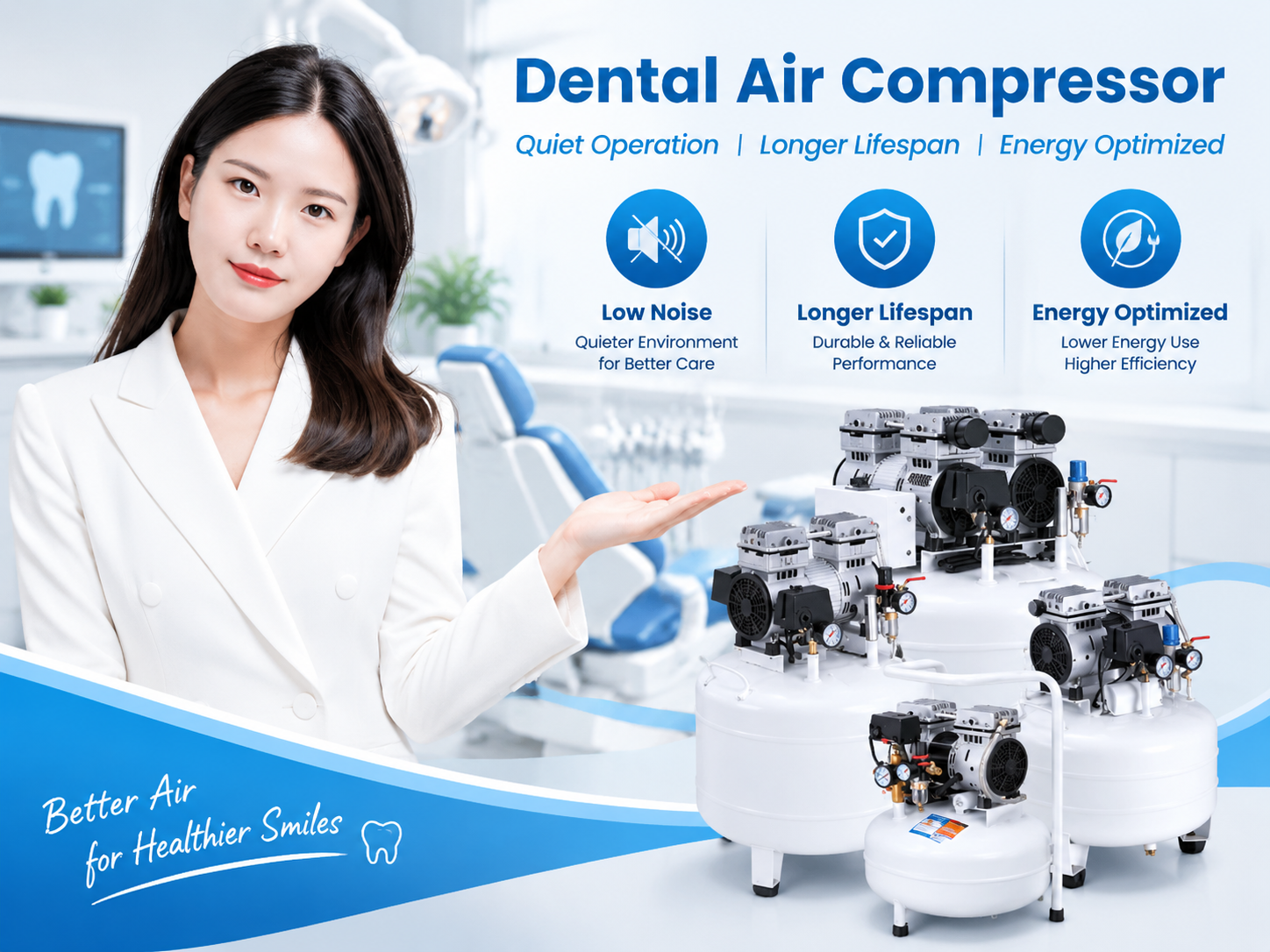
Swap that loud unit for a silent dental air compressor and the whole clinical experience changes.silent dental air compressor The room feels more controlled and less chaotic. You can have normal conversations without raising your voice. Your staff does not have to compete with background noise to explain post-op instructions or discuss payments. The subtle but strong message to every patient is this: This practice invests in quality. This practice cares about your comfort.
Think about a real situation.silent dental air compressor You are presenting a big restorative case to a patient who is already unsure about spending money. Midway through your explanation, the compressor kicks on with a mechanical roar. The patient looks toward the noise. Their brow furrows. The trust you were building breaks. Now picture that same conversation with a silent compressor humming quietly in the background, so soft the patient never even notices it. You keep their attention. You answer their questions without repeating yourself. They say yes to the treatment plan. That single case acceptance can easily cover the price difference between a standard and a silent compressor.
That feeling of professionalism builds trust.silent dental air compressor And trust builds treatment acceptance. Your team also benefits. Constant exposure to loud noise causes fatigue, irritability, and communication mistakes. A quieter clinic keeps everyone sharper and more focused all day. Studies in workplace health have long linked chronic noise exposure to higher stress hormones and lower thinking performance. Your assistants and hygienists make dozens of careful judgments every hour. When their brains are not fighting background noise, those judgments are faster and more accurate.
What Exactly is a Silent Dental Air Compressor?
The word "silent" can be confusing if you expect zero sound.silent dental air compressor No motor-driven machine is completely silent. But the gap between a standard compressor and a well-made silent model is huge enough to feel like night and day.
Decibels, Insulation, and Vibration Isolation: The Science of Silence
Standard dental compressors usually run between 75 and 95 decibel level (dB).silent dental air compressor At 95 dB, you are dealing with sound as loud as a motorcycle or a power saw—enough to make you raise your voice and cause hearing strain over time. A quality silent dental air compressor, on the other hand, works in the 45 to 60 dB range. At 45 dB, you hear a gentle hum, quieter than a library reading room. At 60 dB, it is still softer than normal conversation.
This big drop comes from several noise reduction technology ideas working together.silent dental air compressor First, the motor and pump assembly sit inside a sound-dampening box lined with acoustic foam that absorbs high-frequency noise. Second, the whole unit sits on anti-vibration pads that stop mechanical rumble from moving into the floor and walls. Third, many silent models use low-RPM motors—spinning at 1,400 RPM or less instead of 3,400 RPM—which creates much less mechanical noise and heat. The mix of box insulation, vibration decoupling, and slower motor speed is what makes the "silent" claim real.
One key detail that separates truly quiet compressors from just quieter ones is the quality of the acoustic engineering, not just having a box.silent dental air compressor A poorly built cabinet can actually make some frequencies louder if the insulation is too thin or the panels vibrate at the motor's running speed. What you want is mass-loaded vinyl or multi-layer acoustic foam designed to soak up the frequency range of the pump and motor, usually between 250 Hz and 2,000 Hz. When looking at a silent compressor, ask if the company built the box for sound performance or just wrapped a standard pump in a metal case with minimal lining. The real-world noise difference is large.
Oil-Free vs. Oil-Lubricated: Which is Truly Quieter?
You will face this choice, and it matters for both noise and upkeep.silent dental air compressor An oil-free compressor gets rid of the heavy metal-on-metal contact that creates noise in oil-lubricated pumps. Without oil, there is no piston ring friction and no valve clatter from an oil sump. Oil-free models are usually quieter right away and need much less routine maintenance—no oil changes, no oil filter swaps, no risk of oil getting into your airlines. The trade-off is that oil-free pumps often have a shorter total life. Oil-lubricated compressors, while slightly louder even when well cared for, can run for decades with proper care. For most practices that want patient comfort and simplicity, oil-free is the way the market is heading, but both can give acceptably quiet performance when built into a well-designed box.
A common misunderstanding worth clearing up: the quietness of an oil-free compressor is not because oil itself makes noise.silent dental air compressor The noise difference comes from the mechanical design that oil-free pumps need. Without oil to lubricate, these pumps use special coatings on the cylinder walls and piston rings. They usually run at lower compression ratios per stage. Both of these design features happen to reduce noise as a side benefit. So when you choose oil-free for quietness, you are choosing the engineering approach, not just skipping the oil change.
How to Select the Right Silent Compressor for Your Practice
Buying too small is the most common and most costly mistake.silent dental air compressor An undersized compressor runs constantly, overheats, wears out early, and—most importantly—gets louder as it struggles to keep up. Going a bit big is safer than going too small, but a huge unit wastes energy and space. You need to figure out your actual demand.
Calculate Your True Air Demand: A Simple Worksheet
You cannot just count rooms and guess.silent dental air compressor Different tools use very different amounts of air. Start by listing every air-driven device in your practice and how much air it uses in cubic feet per minute (CFM). A high-speed dental handpiece typically uses 2 to 5 CFM at 35-40 PSI. An air-water syringe may only use 0.5 to 1 CFM. A suction system, if air-driven, can need much more. Add in any lab equipment, air-driven cleaning stations, or other devices. Once you have your list, find the worst-case scenario: What is the most devices you would reasonably run at once during your busiest moment? Add those CFM numbers together to get your peak demand.
Let us walk through a real example.silent dental air compressor Picture a three-room practice running at full capacity. In Room 1, the dentist is using a high-speed handpiece (4 CFM) and an air-water syringe (0.5 CFM). In Room 2, the hygienist is running an ultrasonic scaler with an air-driven water system (2 CFM) and a saliva ejector that needs 1 CFM of air. In Room 3, another dentist is using a slow-speed handpiece (3 CFM) and an air-water syringe (0.5 CFM). Add these up: 4 + 0.5 + 2 + 1 + 3 + 0.5 = 11 CFM of simultaneous demand. That is your peak need. If you bought a compressor rated for 8 CFM because the salesperson said "that should be enough for three chairs," you would be 3 CFM short at peak demand. The motor would run nonstop trying to catch up, never reaching shut-off pressure, and overheating within months instead of years. Always size for the busiest possible moment, not the average one.
Horsepower, Tank Size, and CFM: What Matters Most
Once you know your peak CFM need, you can check compressor specifications.silent dental air compressor Look first at the CFM rating at the pressure your equipment needs—usually between 90 and 115 PSI. Horsepower is a rough guide to CFM output, but two different 5 HP motors can deliver different CFM numbers depending on pump design, so always check the CFM number. The air receiver tank size decides how much compressed air is stored and ready to use. A larger tank smooths out demand spikes and cuts down how often the motor turns on and off. For a multi-room practice, a tank of 40 to 80 gallons is common. The compressor duty cycle tells you what percent of time the motor can safely run. A 100% duty cycle means it can run nonstop. A 70% duty cycle means it needs a 30% rest period. For quiet operation, a compressor that meets your peak demand at a max of 60-70% duty cycle is ideal—it runs rarely and stays quiet.
One mistake that even experienced buyers make is mixing up the compressor's free air delivery rating with what the system actually supplies at the point of use.silent dental air compressor Every foot of piping, every elbow fitting, and every quick-connect coupling causes a small pressure drop. In a practice where the compressor sits in a basement or a faraway utility room with 50 or 100 feet of piping to reach the rooms, you can lose 5 to 10 PSI before the air ever gets to a handpiece. If your equipment needs 90 PSI at the handpiece connection, and your piping layout drops 10 PSI, your compressor needs to keep 100 PSI at the tank just to deliver enough pressure at the chair. Include your piping distance and layout when checking compressor pressure ratings. A unit that looks good on paper in a showroom may not work well in your actual setup if the piping losses are not accounted for.
Keeping It Quiet: Maintenance Secrets for Long-Term Silence
A silent compressor does not stay silent by itself.silent dental air compressor Neglect the basics, and your investment will slowly start making noise again. The good news is that the maintenance routine is simple.
Daily, Weekly, and Monthly Checklists
Every day, you or a team member should drain the air receiver tank to remove built-up moisture.silent dental air compressor Water sitting in the tank causes internal rust. Rusty tank walls make vibration noise louder. Every week, check the intake filter. A dirty filter forces the motor to work harder, raising both noise and energy use. Most intake filters can be cleaned with compressed air or mild soap and water. Replace them according to the maker's schedule. Every month, take five minutes to check every panel screw, fitting, and bolt you can reach. Vibrations can loosen fasteners over time, and a single loose panel can rattle annoyingly against the box.
Common Mistakes That Bring Back the Noise
The most common mistake is ignoring the vibration isolation pads.silent dental air compressor These rubber or neoprene mounts get compressed and harden with age. When they lose their stretch, they stop absorbing vibration and start sending it straight into the floor, turning the building into a sounding board. Replace them at the first sign of cracking or flattening.
Here is a simple test you can do during your monthly check: put your hand flat against the floor about three feet from the compressor while it is running.silent dental air compressor If you feel a clear hum or vibration through the floor, your isolation pads are no longer working. The vibration is entering the building structure, and no amount of acoustic box will fix that. Replace the pads. On most units, this is a 20-minute job that just needs you to slightly tilt the compressor and swap out the old pads for new ones.
Another mistake is putting objects on top of or leaning against the compressor box.silent dental air compressor Anything touching the cabinet creates a path for sound to escape. Keep the area around the unit clear. Do not close the compressor into a small closet without ventilation—overheating speeds up wear on every part and eventually makes operating noise worse.
A related error worth special attention: the temptation to build a homemade soundproof box around a standard loud compressor instead of buying a purpose-built silent model.silent dental air compressor On the surface, this seems like a money saver. You pay a few hundred dollars for wood and acoustic foam instead of several thousand for a new compressor. In practice, this almost always backfires. Compressors give off a lot of heat during operation. Boxing one in without planning proper airflow creates a heat trap that shortens motor life, ruins internal lubrication, and raises fire risk. The box walls also bounce heat back onto the motor, causing it to turn on and off more often as it overheats and cools. Those extra cycles speed up wear. If you want quiet, buy quiet. Do not try to silence a loud compressor after the fact.
The Real ROI of a Silent Compressor: More Than Just Decibels
The upfront cost of a silent compressor is higher than a standard unit, there is no getting around that.silent dental air compressor But focusing on the purchase price misses the full financial picture. This is a revenue-generating investment dressed up as equipment.
How Quiet Equipment Boosts Patient Referrals and Reviews
A patient who feels relaxed during treatment is a patient who says yes to recommended care and tells others about their good experience.silent dental air compressor Reducing patient dental anxiety is not just a nice extra—it directly affects case acceptance rates. When patients do not link your office with stress and noise, they are more likely to book the next appointment, accept a treatment plan for the work they need, and post a review that mentions how comfortable and modern your practice feels. Those reviews are the engine of new patient growth. A single new patient from a positive review can be worth thousands in lifetime revenue. Multiply that over months and years, and the compressor pays for itself in growth you can track.
Longer Equipment Life and Reduced Energy Costs
Many silent compressors are built with efficiency in mind.silent dental air compressor Energy-efficient models may qualify for utility rebates, directly lowering your net cost. Lower operating temperatures and slower motor speeds reduce mechanical stress, which often leads to a longer service life compared to a standard compressor that runs hot and fast. Staff satisfaction is another real but often missed financial factor. Dental compressor maintenance for quiet units is simpler, especially with oil-free models, freeing up team time. More importantly, a quieter, less stressful workplace helps keep skilled team members. Staff turnover in a dental office is costly—finding, hiring, and training replacements takes time and money that a stable, happy team does not need. The combined effect of lower energy bills, better patient retention, more referrals, and reduced staff turnover gives a return on investment that a standard compressor simply cannot match.
Think about this in practical terms. A single dental assistant leaving your practice costs you anywhere from a few thousand to over ten thousand dollars when you add up hiring fees, temporary staffing during the gap, and the lost productivity while a new person gets up to speed. Now ask yourself how much constant workplace noise adds to that assistant's decision to look for other jobs. It is not the only factor, but it is a steady, wearing stressor that builds day after day. When your team can hear each other without effort, when they leave work without the low-level headache that noise causes, they are more likely to stay. Keeping good staff is a compressor ROI that does not show up on a spec sheet, but it is real.
Your clinic ambiance is not some fuzzy luxury. It is a measurable business asset. And a silent compressor is one of the most effective upgrades you can make to protect it.
Frequently Asked Questions
1. What is the typical decibel level of a silent dental air compressor?
A quality silent dental air compressor operates between 45 and 60 dB, which is quieter than normal conversation. This is achieved through sound-dampening enclosures, vibration isolation, and low-RPM motors that dramatically reduce noise compared to standard 75–95 dB units.
2. How do I calculate the right CFM when sizing a silent dental compressor?
List every air-driven device and its CFM consumption, then add the CFM of all units you may run simultaneously at peak demand. Always size for the worst-case scenario—an undersized compressor will run constantly, overheat, and become louder over time.
3. Is an oil-free dental compressor really quieter than an oil-lubricated one?
Yes, oil-free models typically run quieter because they eliminate heavy metal-on-metal contact and have lower compression ratios per stage. However, they may have a shorter service life, so the choice involves balancing noise level with long-term durability.
4. What maintenance keeps a silent compressor running quietly long-term?
Drain the tank daily to prevent internal corrosion, clean the intake filter weekly, and check for loose panels monthly. Also replace vibration isolation pads when they harden or crack—otherwise structural vibration will increase noise even if the enclosure is intact.
5. Does upgrading to a silent dental compressor actually improve patient case acceptance?
Absolutely. A calm, noise-free environment reduces dental anxiety, making patients more receptive to treatment recommendations. This directly boosts case acceptance, referrals, and online reviews, giving the compressor a strong return on investment beyond just decibel reduction.
Tags:air pump | dental compressor with dryer | dental compressor with tank
0users like this.